


TrainKothai - BD Train Tracker
4.55.00 Reviews
App Specs
- Version
- 1.1.7
- Updated On
- License
- Free
- Downloads
- 10,000+
- Developer
- FoodOS
- Categories
- Travel & Local
- Platform
- Android
Screenshots
 Analysis by AppCompare
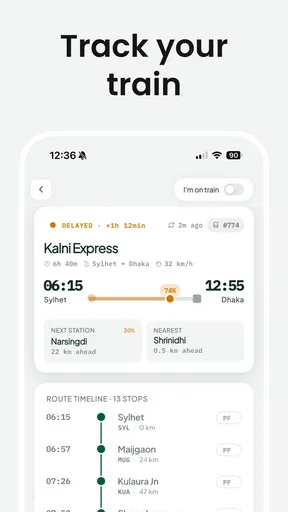
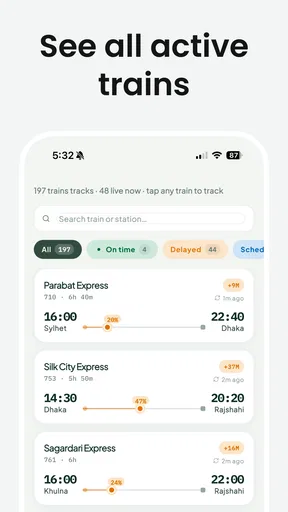
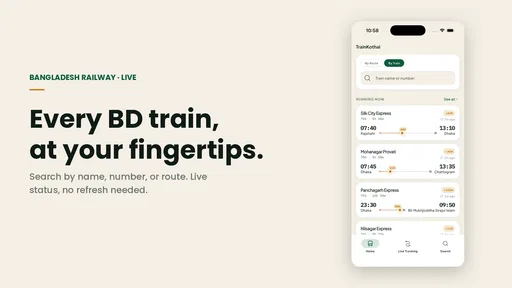
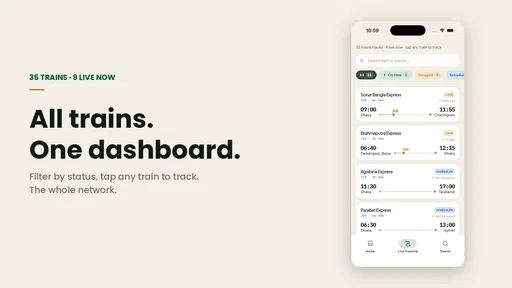
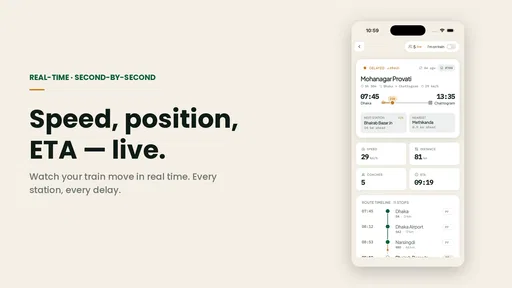
Train travel becomes much less stressful when I can check where a train is instead of relying only on a timetable. That is the practical appeal of TrainKothai - BD Train Tracker, a free Travel & Local app from FoodOS for people who want a simple way to follow trains in Bangladesh. I found its purpose immediately clear: look up a train, check its live location, and see whether delays may affect the journey.
What I like most is that it focuses on a problem travelers actually face. A printed schedule tells me when a train is expected, but it does not help much when I am waiting at a station and the service is late. This app is built around that gap. It is not trying to become a full travel marketplace or a general map application; it is a focused tracker for checking the current situation before leaving home or while waiting.
The app is free and suitable for Everyone, which makes it easy to recommend to families, occasional passengers, and anyone who does not want to pay for a specialized railway tool. Its current version is 1.1.7, and it runs on Android 7.0 or later. With an average rating of 4.5 from roughly 379 ratings and more than 10K installs, it has already attracted a useful group of travelers without feeling like an overcomplicated service.
How I use TrainKothai during a normal journey
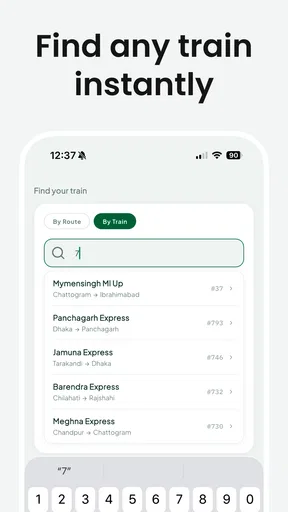
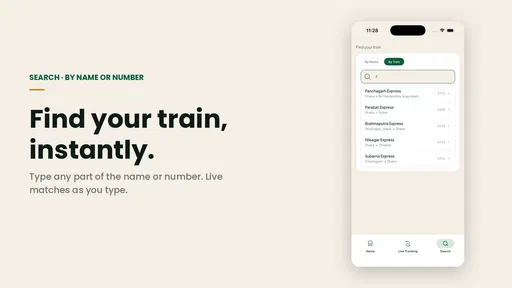
My basic routine is straightforward. Before heading to the station, I open the app and search for the train I plan to take. I use the result as a quick reality check rather than treating the scheduled departure as the whole story. If the train is moving normally, I can leave with more confidence. If the location or delay suggests a problem, I have a reason to allow extra time instead of discovering the issue after arriving.
This is especially helpful when someone is collecting me or when I am coordinating a journey with another person. Rather than sending a vague message such as “the train should arrive soon,” I can first check the current status and give a more useful update. The app therefore works not only for passengers, but also for family members waiting at home or at a destination.
A realistic example is an evening trip after work. I may be deciding whether to leave the office immediately or finish one small task first. A timetable alone cannot answer that question because it assumes the service is following its plan. A live tracker gives me a better basis for the decision. I would still leave a safety margin, but I would not be guessing completely.
The most dependable habit is to check twice: once before travelling to the station and again while waiting. The first check helps with departure planning; the second helps me understand whether the delay has changed. This two-step routine is more useful than repeatedly staring at the same result, because railway situations can change while I am on the way.
Worth Reading Before You Choose

Switching to Android Auto Means Rethinking Your Driving Routine

Google Calendar Makes a Crowded Week Easier to Manage

Baby Panda World Brings Quick Play to Modern Phones, but Its Game Library Feels Busy

ESPN’s Live Game View Makes Following Close Games Easier

QuizzLand Review: A Good Fit for Short Trivia Breaks, Not Every Player

Basketball Stars: Multiplayer Is Fast, but Can It Recover When Matches Go Wrong?
The app is best treated as a decision aid, not a replacement for common sense at the station. I still listen for announcements, watch the platform information, and confirm that the train name and direction match my ticket or plan. A tracker can improve awareness, but it should not be the only source I trust for a time-sensitive boarding decision.
What the focused design gets right
TrainKothai feels more approachable than opening a large mapping app and trying to piece together railway information from several screens. Its purpose is narrow enough that I can approach it with one question: where is my train, and is it delayed? That focus matters when I am standing with luggage, dealing with a weak signal, or trying to help another traveler quickly.
The simple concept also makes it suitable for less technical users. Someone who does not regularly use travel apps can understand the value of searching for a train and checking its status. I would be comfortable suggesting it to a parent or relative who wants reassurance about a journey but does not need a complicated route-planning system.
At the same time, the focused design means I would not expect it to handle every part of a trip. It is not the tool I would choose for comparing routes across different transport types, arranging a hotel, or planning a detailed door-to-door itinerary. For those jobs, a map app, railway booking service, or local transport app may be more appropriate. TrainKothai earns its place beside those tools by answering the narrower tracking question.
Settings and preparation that make checking easier
Experienced use starts before the journey. I recommend opening the app when the trip is still calm and becoming familiar with how train searches are presented. That avoids learning the interface for the first time while standing on a crowded platform. I also keep the exact train name or service details nearby, because searching from memory can be slower when several services have similar names.
I would check the app’s available settings early rather than assuming the default arrangement is ideal. The useful principle is simple: adjust only what makes repeated checking faster or clearer. If the app offers display or notification choices on your device, I would review them and keep the setup restrained. Too many alerts can create noise, while a clean status check is often all I need.
Another practical step is to make sure the phone itself is ready. Live tracking depends on having enough battery and a workable connection, so I would not wait until the final minute to open the app. This is not a special feature of TrainKothai; it is a sensible limitation to account for with any live travel service. A power bank and a saved note containing the train details can make the process less fragile.
I also avoid assuming that a displayed location is an exact promise about arrival at my platform. A train may continue moving, slow down, stop, or face a change that takes time to appear. I use the location to understand the broad situation and combine it with station announcements. That interpretation is more reliable than converting every update into a precise minute-by-minute prediction.
Faster patterns for regular passengers
For a regular route, I would build a repeatable checking habit around the train rather than around random browsing. I keep the journey details ready, open the tracker at the same points in my routine, and compare the latest status with what I expected. This reduces the temptation to search repeatedly without learning anything from the results.
One useful pattern is to check before leaving a familiar location, then stop checking while travelling to the station unless something changes. Once I arrive, I check again and switch my attention to the platform. This balances awareness with battery and attention. Constant refreshing may feel reassuring, but it does not necessarily improve the decision I need to make.
For family coordination, I use one person as the information point. If several people independently check the train and send different interpretations, confusion can increase. A better approach is for one traveler to check the status and communicate a short update, while everyone still confirms the final boarding information locally. This is a small workflow improvement, but it makes a focused tracker more useful in real life.
Another good use is delay planning. If the train is late, I do not only ask whether I can arrive later; I consider connections, pickup arrangements, and food or water needs. The tracker provides the trigger for that planning. It cannot solve the rest of the journey, but it can give me earlier notice that those decisions need attention.
I would also avoid relying on a single old screenshot. A status image can become outdated quickly, especially during an irregular service. If I need to tell someone where the train is, I prefer to give the time of my check and explain that the situation may change. That habit prevents a useful app from creating false certainty.
Where the app may not be enough
The main limitation is inherent in live railway information: the value of the result depends on how current and complete the underlying status is. I would not use one screen as proof that a train will arrive at an exact moment. Delays can develop after an update, and a location view may not explain why a service has stopped or what will happen next.
Connectivity is another practical concern. If I am underground, in a crowded station, or travelling through an area with poor reception, the app may be less useful at exactly the moment I want it. For that reason, I check before leaving and keep official station information as a backup. The app improves my preparation, but it does not remove the need for offline awareness.
I would also skip it if my main need is booking tickets, finding the cheapest fare, or planning a complete multi-leg trip. A dedicated railway booking service is better for purchase-related tasks, while a general map application is stronger for walking directions and transfers. TrainKothai makes sense when live train position and delay awareness are the priority.
Occasional passengers may find that a timetable and station announcement are enough for a short, familiar journey. In that case, installing another app may not add much value. The strongest reason to use this one is uncertainty: a long trip, a pickup at the destination, a tight connection, or a service where delays would cause real inconvenience.
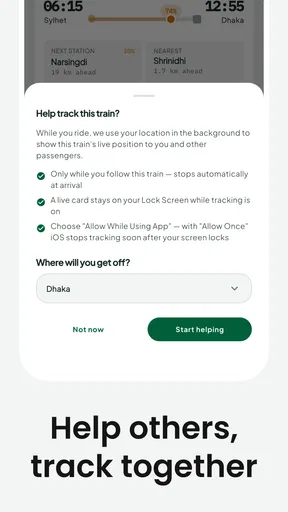
Privacy and device comfort also deserve ordinary attention. I would review any access requests shown by the phone and avoid granting permissions that do not seem necessary for the way I intend to use a tracker. I would also keep notifications limited to what helps me. The goal is a calmer journey, not another source of interruptions.
Who will get the most from it?
I think the best audience is anyone travelling by train in Bangladesh who wants a quick status check without paying for the tool. Commuters can use it to decide when to leave. Long-distance passengers can use it to update relatives. Students and occasional travelers can use it to reduce uncertainty before reaching the station.
It is also useful for people who are not travelling themselves but need to coordinate with someone who is. A parent waiting for a child, a friend meeting a visitor, or a driver planning a station pickup can all benefit from knowing whether the train is broadly on schedule. The app’s value extends beyond the person holding the ticket.
I would be more cautious about recommending it to someone who expects exact arrival guarantees or a complete travel assistant. Those expectations go beyond what a focused tracker should provide. For a person who wants one app to search routes, buy tickets, navigate streets, and manage reservations, a broader travel platform will be a better fit.
My verdict after building a routine around it
TrainKothai - BD Train Tracker succeeds because it addresses one specific travel worry without asking me to learn a large system. I can use it before leaving, check again at the station, and use the result to coordinate with others. The free price and Everyone rating make it an easy addition for travelers who want a low-risk way to improve their preparation.
FoodOS has positioned the app as a practical Travel & Local utility rather than a general-purpose travel platform. That choice is both its strength and its boundary. I appreciate the direct purpose, but I would pair it with station announcements and another tool when I need ticketing, route planning, or precise walking directions.
My final recommendation is positive, with one condition: use the tracker intelligently. Keep the train details ready, check at meaningful moments, interpret live status as guidance rather than a guarantee, and maintain a backup plan for weak connectivity or changing railway conditions. If that matches the way you travel, TrainKothai - BD Train Tracker is a sensible free companion for making train journeys feel more predictable.
Pros
- Shows Bangladesh train schedules and routes in one place.
- Useful for checking train names
- stations
- and departure times.
- Simple interface that is easy to navigate for most users.
- Helps passengers plan journeys before visiting the station.
- Convenient for regular travelers using Bangladesh Railway services.
Cons
- Schedule information may change without immediate updates.
- Coverage can be limited for unusual routes or smaller stations.
- Some features may depend on an active internet connection.
- Train delays and platform changes may not be reflected live.
- The app may contain ads or require permissions some users dislike.
FAQs for TrainKothai - BD Train Tracker
What is TrainKothai - BD Train Tracker used for?
TrainKothai - BD Train Tracker is designed to help passengers check information about trains operating in Bangladesh. It can be useful for viewing train schedules, route details, station information, and expected travel times in one place. Before relying on the app for an important journey, users should compare its information with official railway announcements, particularly during holidays, service disruptions, or timetable changes.
Does TrainKothai provide live train tracking in Bangladesh?
The app is intended to help users follow Bangladesh train services, but the availability and accuracy of live tracking may depend on data sources, network access, and whether a particular train or route is supported. Some information may be schedule-based rather than a precise real-time location. For the most reliable update, passengers should also check announcements at the station or information published by Bangladesh Railway.
Can I use TrainKothai without an internet connection?
Some previously loaded details may remain visible temporarily, but features that require updated schedules, live status, route searches, or other online data generally need an active internet connection. Performance can also vary with mobile signal quality. If you are traveling through areas with weak coverage, it is sensible to check your journey details in advance and save essential information before leaving.
Is TrainKothai an official Bangladesh Railway application?
TrainKothai - BD Train Tracker should not automatically be considered an official Bangladesh Railway service simply because it provides railway-related information. Users should review the developer details, privacy information, and app description on the relevant app store before downloading. The application may be a third-party tool that gathers publicly available information, so official railway sources remain important for tickets, cancellations, fares, and urgent notices.
Is TrainKothai safe to download and what permissions might it require?
Download TrainKothai only from a trusted app store or a verified source, and check recent reviews, update history, developer information, and requested permissions first. A train-tracking app may request internet access and possibly location access for nearby station or location-based features. Avoid granting permissions that seem unrelated to its purpose, and read the privacy policy to understand how personal or location data may be handled.


